The Maserati brothers, Alfieri, Bindo, Carlo, Ettore, and Ernesto, were all involved with automobiles from the beginning of the 20th century. Alfieri, Bindo, and Ernesto built 2-litre Grand Prix cars for Diatto. In 1926, Diatto suspended the production of race cars, leading to the creation of the first Maserati and the founding of the Maserati marque. One of the first Maserati’s, driven by Alfieri, won the 1926 Targa Florio. Maserati began making race cars with 4, 6, 8, and 16 cylinders (two straight-eights mounted parallel to one another).
The trident logo of the Maserati car company, designed by Mario Maserati, is based on
the Fountain of Neptune in Bologna's Piazza Maggiore. In 1920, one of the Maserati brothers used this symbol in the logo at the suggestion of family friend Marquis Diego de Sterlich. It was considered particularly appropriate for the sports car company due to the fact that Neptune represents strength and vigor; additionally the statue is a characteristic symbol of the company's original home city of Bologna.
Alfieri Maserati died in 1932, but three other brothers, Bindo, Ernesto, and Ettore kept the firm going.
In 1937, the remaining Maserati brothers sold their shares in the company to the Adolfo Orsi family, who, in 1940, relocated the company headquarters to their home town
of Modena, where it remains to this day. The brothers continued in engineering roles with the company. Racing successes continued, even against the giants of German racing, Auto
Union and Mercedes. In back-to-back wins in 1939 and 1940, an 8CTF won the Indianapolis 500, making Maserati the only Italian manufacturer ever to do so.[9]
The second world war then started and Maserati abandoned car making to produce components for the Italian military. During this time, Maserati worked in fierce competition to construct a
V16 town car for Benito Mussolini before Ferry Porsche of Volkswagen built one for Adolf Hitler. This failed, and the plans were scrapped.
After the war Maserati returned to making cars and key people joined the Maserati team. Alberto Massimino, a former FIAT engineer with both Alfa Romeo and Ferrari experience, oversaw the design of all racing models for the next ten years. With him joined engineers Giulio Alfieri, Vittorio Bellentani, and Gioacchino Colombo. The focus was on the best engines and chassis to succeed in car racing which resulted in the A6GCS.
Maserati A6GCS
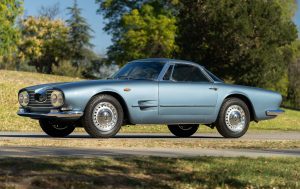
The famous Argentinian grand prix driver Juan-Manuel Fangio raced for Maserati for a number of years in the 1950s, achieving a number of stunning victories including winning the world championship in 1957 in the 250F. Maserati retired from factory racing participation because of a terrible crash during the 1957 Mille Miglia killing the driver and co-driver and nine spectators of which 5 were children. Maserati became more and more focused on building road-going grand tourers.
In 1968, Maserati was taken over by Citroën. With secure financial backing, new models were launched and built in much greater numbers than years prior. The first new arrival was the 1969 Indy—a Vignale-bodied four-seater GT with a traditional V8 drivetrain, 1,100 units of the
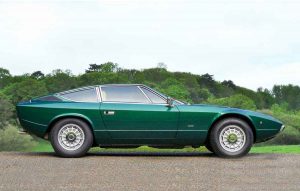
Indy were made. In 1971, the Bora was the company's first series production mid-engine model, an idea agreed with administrator Guy Malleret shortly after the 1968 takeover. The Bora ended Maserati's reputation for producing fast but technologically out of date cars, being the first Maserati with four wheel independent suspension. In contrast, competitor Lamborghini already used independent suspension since 1964. In 1972, the Bora was transformed to the Merak, now employing a SM-derived V6 enlarged to 3.0-litres. That same year the Bertone-designed Khamsin was introduced which was produced until 1974.
Maserati Khamsin
Meanwhile, the 1973 oil crisis put a halt to the ambitious expansion of Maserati; demand for fuel- hungry sports cars and grand tourers shrank drastically by 60–70%. The only Maserati automobile that continued to sell in appreciable numbers was the small-displacement Merak. In 1974 things took a turn for the worse. Citroën went bankrupt and its incorporation into PSA Peugeot Citroën began. The year closed with domestic sales tumbling from 1973's 360 to 150 units. On 8 August 1975, an agreement was signed at the Ministry of Industry in Rome, and Maserati passed from Citroën to Italian state-owned holding company GEPI and Alejandro de Tomaso, an Argentinian industrialist and former racing driver, he became president and CEO
Beginning in 1976, new models were introduced, sharing their underpinnings—but not their engines—with De Tomaso cars; first came the Kyalami grand tourer, derived from the De Tomaso Longchamp, restyled by Frua and powered by Maserati's own V8. Following the Kyalami was the Giugiaro-designed Quattroporte III based on the De Tomaso Deauville, which was introduced in 1976 and put on sale in 1979.
The Bora's sales dwindled down; the Khamsin was discontinued between 1982 and 1983. Progressively stripped of its Citroën-derived parts, the Merak continued to sell over one hundred units a year, until 1982.